Statement of the artworks in Forest Art Festival 2026
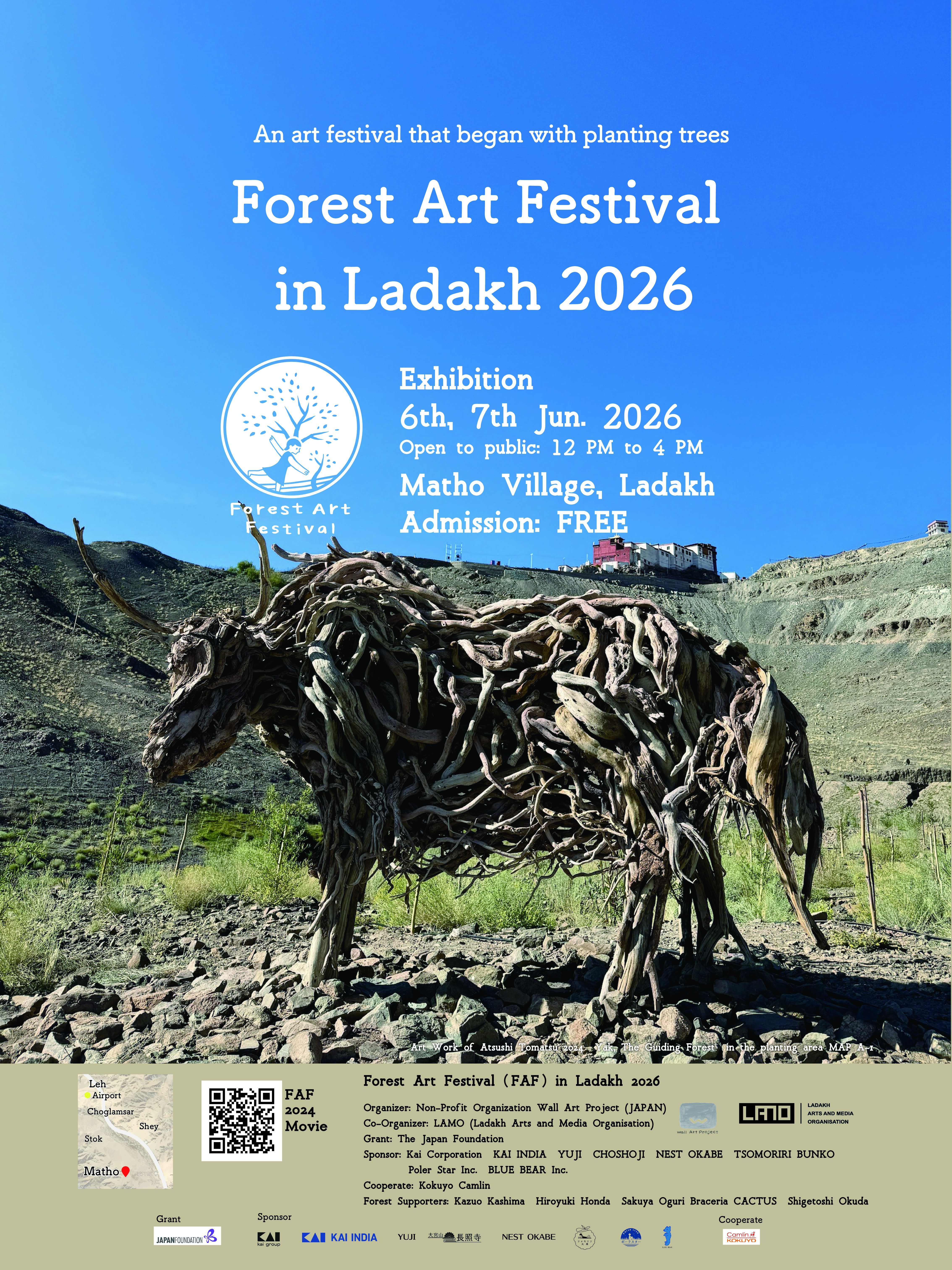
A-1
Yusuke Asai -Artist
The constellations of the Earth ”Messenger of the Wind King”, 2024
Land Art on upper part of plantation area
Materials: Sun dried bricks, lime
Size: 280m×130m
From ancient times, constellations were created by peopleʼ s imaginations in many regions, and numerous stories were born and passed down through the generations. In Ladakh, a beautiful land that is especially close to the sky on this planet, I have fulfilled my 20-years dream by creating a geoglyph here.
I believe that this work, with lines made of sun-dried bricks and lime that span over 1 kilometer in length, will eventually return to the earth. However, within this magnificent landscape, I connected rocks that serve as landmarks, much like connecting stars to form constellations, and created an image where plants and animals intermingle.
I believe that plants have the power to analyze and adapt to their environment, flexibly creating forms, while animals have the ability to move to environments that suit them and sometimes even transform those environments. Additionally, I think that humans are capable of balancing both plant-like and animal-like thinking.
I am grateful to have created my work at this Forest Art Festival (FAF2024), as a guardian presence for the 6,100 trees planted in the direction the living beings are heading. I also want to express my deep appreciation to everyone in this land for warmly accepting my work and providing immense help.
A-2
Yusuke Asai -Artist
The constellations of the Earth ”Messenger of the Earth King”, 2024
Land Art on upper part of plantation area
Materials: Soil, Cloth
Size: 25m×15m
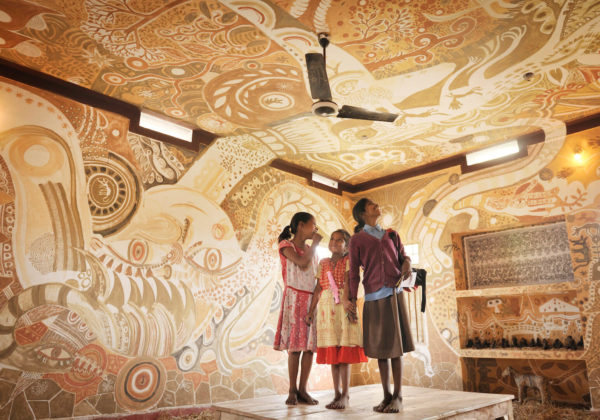
Among the three geoglyphs, the only movable one made of fabric is the same size as the community hall’s rooftop. This work was created in collaboration with many Ladakhi artists, using soil from areas such as Matho, Shey, Stok, Tso Moriri, and SECMOL.
A-3
Atsushi Tomatsu -Sculptor
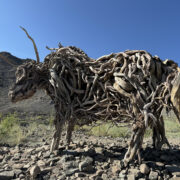
Yak, The Guiding Forest, 2024
Materials: Driftwood, Screws
The animals’ destination is fertile land. It watches over the still small trees planted in Matho, hoping that they will grow and eventually become a guiding presence and place for the animals and people who visit this land.
A-4
Atsushi Tomatsu and Students of Gov.High School, Matho
Gurdian Creature, The Weaving Tree, 2026
Materials: Driftwood, Screws
The driftwood carried by the Matho River, shaped by Himalayan glaciers, seems to hold traces of memory and life forms from ancient times to the present. Touching this driftwood, with its power to awaken the imagination, children breathed life into new beings with their own hands. The word “Creature” carries a different resonance from “Beast,” which evokes strength, power, and solemnity. Rather, it suggests a gentler and more mysterious presence of life. It goes beyond the meaning of an animal, referring instead to a being born from the spirit of the earth and the forest, or quietly shaped by nature itself. These guardian creatures, brought into existence by the children, are not only meant to watch over the young trees as they take root and grow, but also to connect and warm the hearts of the people who care for them. It is our hope that they will become companions that nurture a sense of belonging, imagination, and connection between people and the forest.
A-5
Chemat Dorjey -Sculptor
The Wind Horse / Rlung Rta , 2026
Materials: Driftwood, Screws
FAF 2026 , Matho Ladakh
Rlung rta: the Wind Horse, Himalayan symbol of vitality, energy, and the unbreakable spirit.
This horse is carved from driftwood — wood that has traveled, weathered, and survived. Each grain holds the memory of water, wind, and time. Assembled here at Matho it becomes a vessel for lungta, the life force that moves through all living beings.
Wings outstretched, mid-flight, the horse doesn’t just carry form — it carries intention. Like the prayer flags strung across Ladakhi passes, this work sends hopes upward. Swift as mountain wind, weightless as faith, it embodies transformation, healing, and personal empowerment.
The sculpture speaks to deep interconnectedness: nothing exists alone. A strong lungta attracts fortune, protection, prosperity. A weak one invites struggle. Here, the Wind Horse rises — not as decoration, but as blessing for the land, the monastery, and every being who passes beneath its wings.
B-1
Ryohei Shimada -Artist
Constellation of the Earth (Messenger of the Water King)”, 2026
Materials: Acrylic paint
In Ladakh, the sky feels close.
Here, the sky seems to be seamlessly connected to the earth beneath our feet.
This is my second time visiting Ladakh, a land where all the elements of nature—wind, water, light, and soil—intersect. Two years ago, as an assistant to Yusuke Asai, I participated in FAF2024. Together with local artists and Japanese volunteers, we created one of the geoglyphs titled “Constellation of the Earth (Messenger of the Water King).” This time, I joined FAF2026 in order to breathe new life into that work. I created this painting as a presence that connects the tree-planting site and the reservoir, and as a being that watches over the trees. Amid days of constant change, the Messenger of the Water King continues to gaze upon the earth of Matho, connecting trees and water, sky and earth, people and people, while gradually becoming part of the lives of the people of this land.Dreaming of the day when the trees in the planting site will grow and one day become a forest.
C-1
Chihaya Oguri -Manga Artist
Wild Rose, 2017, 2026
Materials: Acrylic paint
A mural that can never be completed without the collaboration of its participants. With every color chosen and every flower placed in a unique spot, the strange and wondrous Wild Rose Tree grows ever more vibrant, gathering new life with each contribution. Wild Rose has a deep desire to be seen and to connect with others. In that way, it resembles flowers, vivid creatures, and human beings alike. Its beauty and vitality emerge through the presence and participation of those who encounter it. The mural created through a workshop in 2017 was damaged over time. He restored the mural while conducting a new workshop to make wild roses bloom once again.
Please join the workshop — anyone can easily create flowers using a stencil technique.
C-2
Chihaya Oguri -Manga Artist
Parade of the Neighbors, 2026
Acrylic paint
Within our minds, we draw invisible lines: between what deserves our attention and what does not, between what reaches our hearts and what we choose not to feel. But perhaps these lines are far more fragile than they appear.Just beyond the realm of comfort and convenience, propelled by cities, education, and economies, our neighbors wander through the vast flow of time, carrying stories of their own. Existing at the edge of our awareness, they invite us to imagine worlds that lie beyond the boundaries we have drawn.
C-3
Chihaya Oguri -Manga Artist
LIZARD BALL, 2026
Acrylic paint
The legendary Matho Village folk tale Lizard Ball is finally becoming a manga! Collect all seven and any wish will come true? Nope. Absolutely not. That doesn’t seem likely at all. Instead of an epic quest for the Lizard Balls, what unfolds is a rather underwhelming little story. But somehow, its unlikely hero may have crossed seas and centuries to find a place in our hearts.And that’s the whole story. The end.
C-4
Tsering Youdol -Visual Artist
Maryul, 2026
Acrylic paint
This mural is inspired by the life and heritage of Matho. It shows the monastery, farming traditions, willow trees, and the historic trade between Matho and Changthang. The exchange of grain and salt represents the strong connections between people, their livelihoods, and the land. With this, the mural celebrates the spirit of Maryul—the Red Land of Ladakh.
C-5
Jamyang Namgail -Visual Artist
Confluence: Nomad and Cultivator, 2026
Acrylic paint
This painting reflects the enduring relationship between the nomad and the cultivator in Ladakh, two communities whose lives have long been interconnected through exchange, cooperation, and shared dependence on the land. Rather than existing as separate worlds, pastoralism and agriculture are portrayed as complementary ways of life that sustain one another.
The flowing blue and yellow ribbons represent the traditional fabrics of Ladakh. Their movement across the wall echoes the contours of the surrounding mountains, merging textile traditions with the natural landscape. The blue ribbon symbolizes the nomadic world—movement, water, sky, and seasonal migration across high-altitude pastures. The yellow ribbon represents the cultivator—earth, harvest, warmth, and rootedness. As the ribbons intertwine, they visualize the social, cultural, and economic bonds that connect herders and farmers.
At the center of the composition is a traditional measuring bowl, historically used as a volumetric measure in the barter and butter-trading system. More than a utilitarian object, the bowl symbolizes exchange, trust, and reciprocity between communities. Positioned at the meeting point of the ribbons, it represents the flow of goods, knowledge, and relationships that linked nomadic and agricultural households across Ladakh.By bringing together fabric, mountain, and trade, the painting celebrates a shared heritage in which mobility and settlement, pasture and field, are woven into a single living fabric of Ladakhi life.
D-1
Vayeda brothers -Warli Artist
Little Things, 2026
Water based paint
This painting reflects the enduring relationship between the nomad and the cultivator in Ladakh, two communities whose lives have long been interconnected through exchange, cooperation, and shared dependence on the land. Rather than existing as separate worlds, pastoralism and agriculture are portrayed as complementary ways of life that sustain one another.
The flowing blue and yellow ribbons represent the traditional fabrics of Ladakh. Their movement across the wall echoes the contours of the surrounding mountains, merging textile traditions with the natural landscape. The blue ribbon symbolizes the nomadic world—movement, water, sky, and seasonal migration across high-altitude pastures. The yellow ribbon represents the cultivator—earth, harvest, warmth, and rootedness. As the ribbons intertwine, they visualize the social, cultural, and economic bonds that connect herders and farmers.
At the center of the composition is a traditional measuring bowl, historically used as a volumetric measure in the barter and butter-trading system. More than a utilitarian object, the bowl symbolizes exchange, trust, and reciprocity between communities. Positioned at the meeting point of the ribbons, it represents the flow of goods, knowledge, and relationships that linked nomadic and agricultural households across Ladakh.By bringing together fabric, mountain, and trade, the painting celebrates a shared heritage in which mobility and settlement, pasture and field, are woven into a single living fabric of Ladakhi life.
E-1
Daisuke Kagawa -Painter
Returning Here Again, 2023
Acrylic paint
When will that someday be,
when we return once more?
Round and round,
the road we once came by,
the same road again.
Trees and people already knew
the path where the dry whirlwind passes.
Though they could not have known,
they knew.
A story from far beyond.
There is no beginning and there is no end.
We know, even as we have forgotten, that we will return here again.
To myself and to all that is not myself—hello for the first time, and goodbye.
E-2
Atsushi Tomatsu -Sculptor
Ibex, The Gazing Mountain, 2024
Materials: Driftwood Screws
Atsushi Tomatsu encountered a family of ibex on the cliffs of near Matho river.
“Their gaze posed a silent question to me.”

この記事へのコメントはありません。